Hola, profes de español! Ever feel like teaching the Spanish verb gustar is secretly a grammar trap waiting to ensnare your students with indirect object pronouns (me, te, le, nos, os, les), plural forms, infinitives, and that weird order (English speakers, raise your hand)? Yeah, me too. Teaching regular Spanish verbs and conjugations is tricky enough, but verbs like Gustar take it to the next level. But—what if I told you there’s a great way to introduce gustar that gives students TONS of input, culture, and laughs, with almost zero prep? Because we all know, gustar is one of the most important verbs for your students to know to express their feelings in Spanish.
Cue the magic of Picture Talk. This blog post will show you how to plan a lesson that helps your Spanish learners master gustar (including gustar conjugation, indirect object pronouns, etc.) in a natural, communicative, immersion‐friendly way. You’ll see why this is one of the most effective ways to teach me gusta / te gusta / les gusta, new language, and an awesome grammar skill for your Spanish class. Read on to check out the details!
Why Picture Talk + Gustar Is a Winning Combo
Before we jump into the plan, a quick peek at why Picture Talk works—for novice learners, middle school, or high school students:
- They get comprehensible input: Students see an image, you ask questions, they hear gustar used in context (plural forms, singular, object vs. infinitive form).
- You avoid the “literal translation” trap: instead of saying “gustar = to like,” students see subject of the sentence isn’t always obvious, learn “Me gusta + noun / verbo,” “Les gustan + plural noun,” etc.
- Culture + visuals: Using authentic images (often art or photos from Spanish‐speaking countries), you bring in authentic resources that show how real people use gustar and like/dislike structures.
- Small groups or whole class? Both work well and helps build confidence slowly in a low stress environment.
So let’s see how to build a lesson plan with gustar using Picture Talk. I’ll show you a no-prep example, which makes your lesson ready to go 🙂
Step‐By‐Step Picture Talk Lesson Plan: Teaching Gustar
Here’s a reliable template you can reuse anytime (weekend chat with students, test prep week, or just when you want something fresh in your syllabus). You will love how plug-and-play this is, which makes the time you spend on lesson planning decrease. Woo hoo!
1. Brief Intro: Subject Pronouns + Indirect Object Pronouns
Start with a short mini‑lesson or a hook: review subject pronouns (yo, tú, él/ella, nosotros, ellos) if needed, then introduce indirect object pronouns (me, te, le, nos, les). Explain “gustar” is different: the thing liked is more like the subject of the sentence, and the person who likes it is expressed via the indirect object pronoun. You can use this short and sweet (freebie) guided notes sheet to help fly through the pop-up grammar lesson.
Give example: Me gusta el fútbol. Te gustan los libros. A ella le gusta bailar. Nos gusta comer comida mexicana. And talk about plural form: me gustan las manzanas vs me gusta la manzana.
You might need to model the infinitive form too: Me gusta bailar, Te gusta correr, etc.
This mini grammar skill sets up everything else. OR…. (my favorite approach) you can use it as a wrap-up after giving them tons of examples in context.
2. Picture Talk Activity
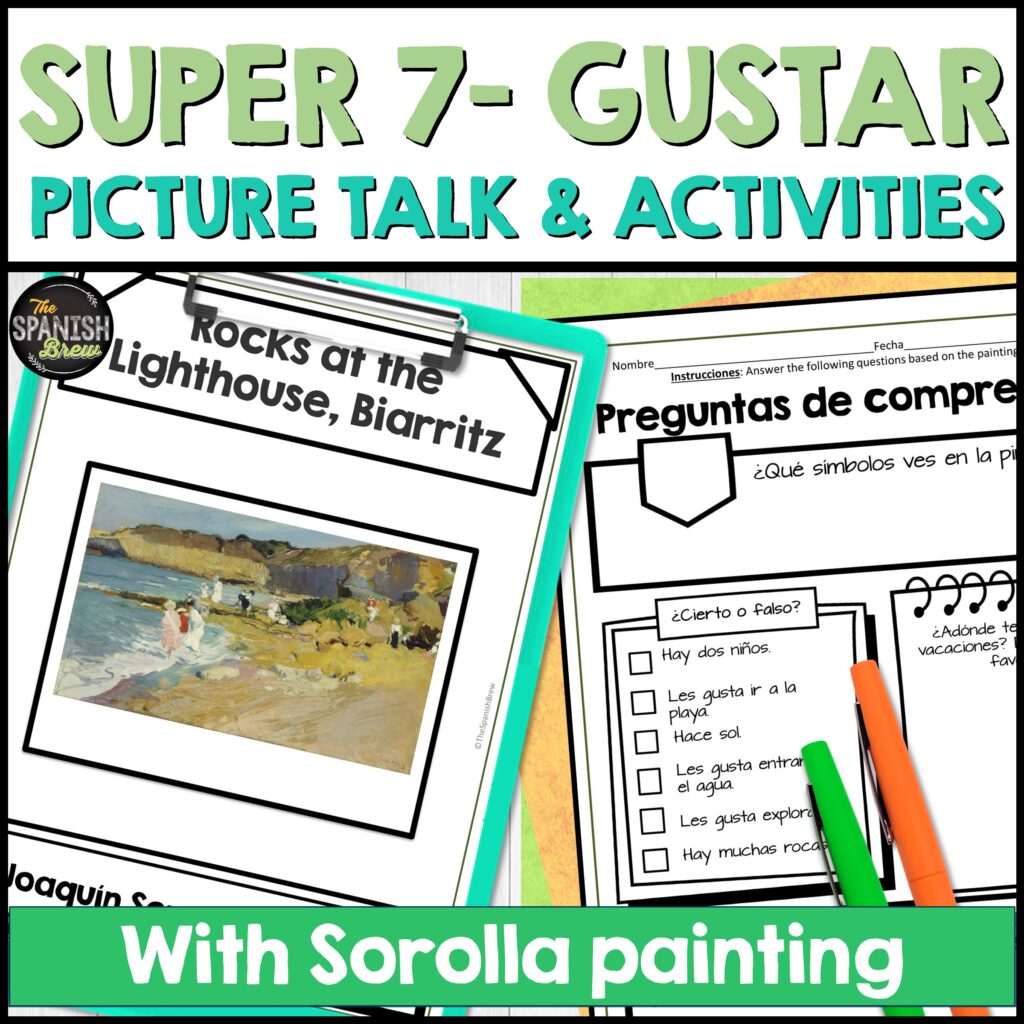
Start by using this zero prep resource:
Spanish Activities for High Frequency Verb Gustar Picture Talk CI Activity (Click here)
This is where your students get tons of input without needing to memorize lists first—they see gustar in action, with visual supports and context. You can slow down or speed up your questions depending on how fast the class is grasping the Spanish. They will love how low-stress this is and the comparisons you can make to their own preferences. Even a quick “thumbs up/thumbs down” gives you a sense if they’re comprehending the Spanish.
What it includes & how to use it:
- Authentic pictures / artworks you project or display (or show via interactive whiteboard)
- Questions in Spanish designed to target gustar conjugation, subject pronouns, indirect object pronouns, te gusta / le gusta etc.
- Students listen, point, discuss in small groups, whole class, or pairs.
- Comprehension checks built in: true/false, identify the correct gustar use, noticing plural vs singular, etc.
3. Comprehension Activities
After the Picture Talk, check their comprehension with some quick worksheets. Use the included comprehension questions from the resource:
- True/false statements: For example,“ ¿A la chica le gusta la playa?”
- Draw to demonstrate comprehension.
- Writing sentences to demonstrate comprehension.
- Answering personal questions to make connections to the artwork.
These help students process the grammar, notice gustar conjugation, and absorb indirect object pronouns more naturally. The beauty is that they’re using the grammar naturally to express their thoughts and opinions.
4. Student Drawing + Presentation
Now for the creative twist—students make their own drawing / digital mystery picture / art in the style you saw (or just loosely inspired). They choose things they like / don’t like, use gustar + noun or gustar + infinitive, plural form vs singular form, indirect object pronouns, etc. You can have them draw by hand or even use AI to help generate their image to include technology into the lesson.
Then they present their drawing to the class (or in small groups), saying sentences like “A mí me gusta el perro”, “A Juan le gustan las flores”, “Me gusta + leer libros”, etc.
Display them in the hallway or on your classroom wall—it gives culture, language, and student pride.
Extra Tips: Infusing More Input & Culture
Since you want to maximize input (and culture!), here are a variety of techniques to throw in and extend the activity:
- Use video for extra reinforcement: movies, short film clips, or commercials from Spanish-speaking countries where people say me gusta / te gusta. You could do a mini movie talk about what people seem to like in the clip.
- Use games like matamoscas and simon dice to practice expressions like: “¿Qué te gusta más?” (this vs. that), “Me gusta / Me gustan,” etc.
- Use prepositional phrases for added complexity: Me gusta la música de Juanes / A ella le gusta cantar en el parque / A nosotros nos gusta bailar salsa.
- Put up a word wall with gustar + various cognates or infinitives students can use. Giving them visual support reinforces the grammar while decreasing stress/pressure over using the language until it feels natural.
Common Pitfalls & How to Avoid Them
Students are going to make “grammar mistakes.” They even do this in their first language when they’re little. (My 8-year-old still says things like “They had-ed to go to the park”). So gustar can be tricky because it doesn’t work like “regular” verbs in Spanish. Here are a few grammar quirks that often trip up learners that I’ve noticed from my students over the years, with small ways to preempt them (spoiler alert, the best way to remedy this is seeing/hearing the Spanish in context):
| Problem | Quick Fix |
|---|---|
| Students say “Yo gusto…” | Input, input, and more input! They’ve gotta see/hear it many times before it “sounds right” to them. |
| Confusing plural vs singular (e.g. Me gusta las manzanas) | Use paired examples with visuals showing one vs many; practice both often |
| Forgetting the “a + name / a + él / a + ella” phrase when clarifying | Model it, include it in student speaking, or have students fill it in |
| Literal English translation leading to wrong structure | When doing Picture Talk or comprehension, compare structure: “I like pizza” vs “Pizza pleases me” (if you want to mention literal idea), but always model correct Spanish structure |
Why Picture Talk Helps Students Master Spanish
- Students get new language in context—seeing gustar, te gusta, le gusta, and les gustan in real sentences, not just lists.
- It’s immersive: almost all speaking or listening is in the target language during Picture Talk.
- It engages small groups, whole class, plus visual + the authentic art supports so different learning styles are included.
- Grammar skill + communication: students end up using subject pronouns, indirect object pronouns, infinitive forms, and expressing liking/disliking without falling back into English.
Sample Lesson Plan Timeline
Here’s a sample timetable for a 50‑minute class:
| Time | Activity |
|---|---|
| 0‑5 min | Warm up: Ask “¿Qué te gusta hacer los fines de semana?” in pairs to activate prior knowledge. I love to throw example answers with basic clip art on the projector to help them boost their confidence. |
| 5‑15 min | Pop-up grammar. Brief review of subject pronouns + indirect object pronouns + example sentences. (You can also do this after the lesson to review once they’ve seen the grammar in action. This is my strategy). |
| 15‑30 min | Picture Talk activity, projected on interactive whiteboard, class + small groups |
| 30‑40 min | Comprehension questions + partner talk: “¿Qué le gusta al hombre?” “¿Le gustan los perros?” etc. |
| 40‑50 min | Drawing task + presentation + quick reflection: what was easy/hard with gustar + feedback |
Wrapping Up & Your Teaching Move
If I were to summarize one big teaching move here: Picture Talk with Spanish verb gustar gives students tons of target language input, lets them see and use plural form, indirect object pronoun le / les, infinitive form, subject of the sentence, etc., all without boring grammar lectures. It’s fast, flexible, and powerful.
So, if you’re planning your gustar unit, this approach is one of the most effective ways to help learners master gustar + likes/dislikes, build confidence, and deepen cultural awareness. Plus, your students get to see real images (yay, easy way to include culture), express real preferences, and—even better—you don’t have to spend Saturday afternoon prepping it.
Happy planning!
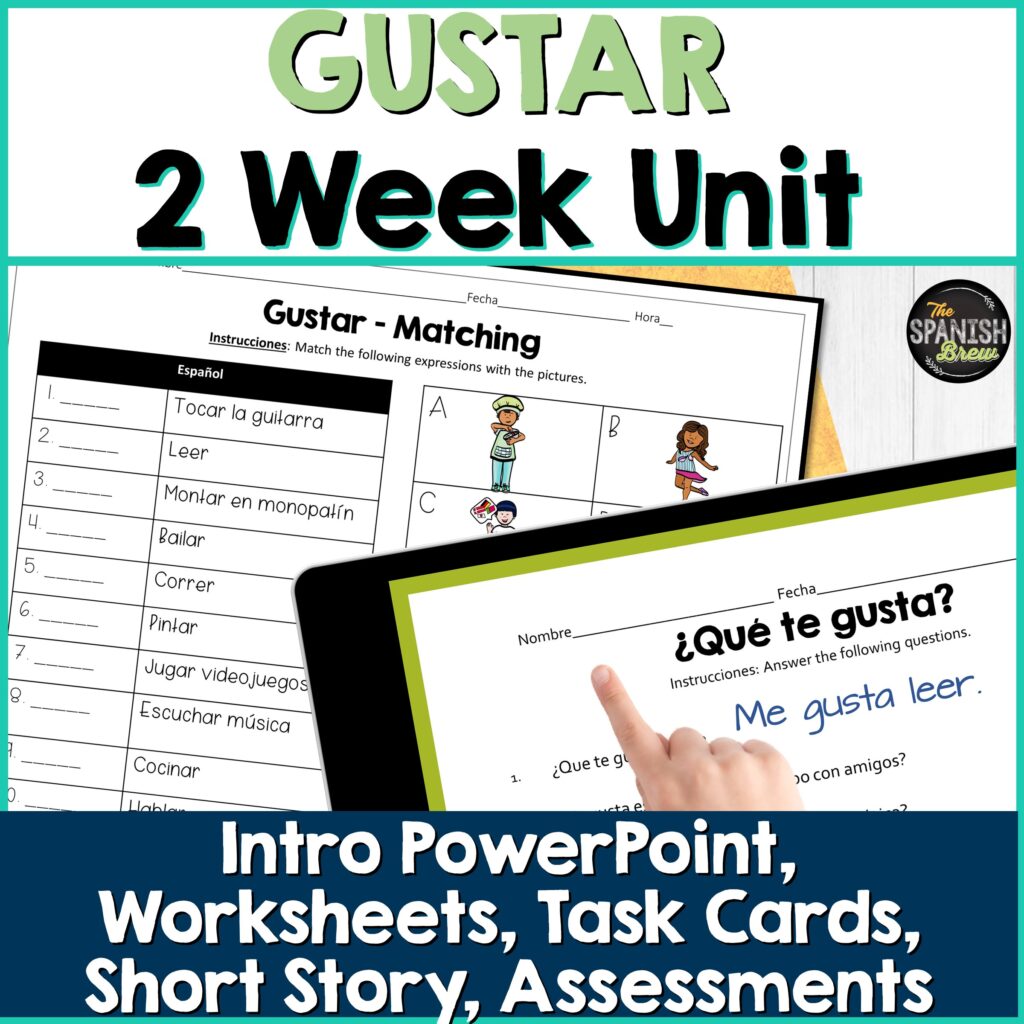
Looking for even more Gustar Activities?
Check out this bundle of activities that will last you 2 weeks! (Or save some of them to review before exams):
Related blog posts:



No Comments